
Welcome to the Mathematical World!
Satyendra Nath Bose
Pioneer of Quantum Statistics
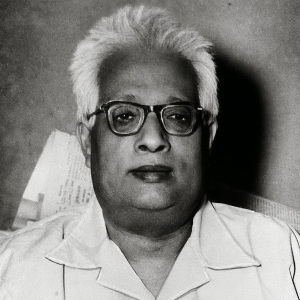
Satyendra Nath Bose (1894–1974) was an Indian physicist and mathematician, best known for his groundbreaking work in quantum mechanics, particularly in the development of Bose-Einstein statistics. Born in Kolkata, India, Bose showed remarkable talent in mathematics and physics from an early age, eventually becoming a lecturer at the University of Dhaka and later at the University of Kolkata.
Bose-Einstein Statistics
In 1924, Bose sent a paper on the quantum statistics of photons to Albert Einstein, who recognized its significance and extended it to atoms. This led to the formulation of Bose-Einstein statistics, describing a class of particles now called bosons. Bosons are particles that obey the following statistical distribution:
\[ n_i = \frac{1}{e^{(E_i - \mu)/kT} - 1} \]where \( n_i \) is the average number of particles in the \( i \)-th energy state, \( E_i \) is the energy of the state, \( \mu \) is the chemical potential, \( k \) is Boltzmann's constant, and \( T \) is the absolute temperature.
Bose-Einstein Condensate
Bose’s work predicted a new state of matter, now called the Bose-Einstein Condensate (BEC), in which a large number of bosons occupy the lowest quantum state at extremely low temperatures. This phenomenon was first observed experimentally in 1995, decades after Bose's theoretical predictions.
Contributions Beyond Quantum Mechanics
Besides his work on quantum statistics, Bose made significant contributions to:
- Statistical mechanics and thermodynamics
- Electromagnetism and the theory of light
- Theoretical physics education in India, inspiring generations of students
Legacy
Satyendra Nath Bose’s pioneering work in quantum mechanics earned him international recognition and a lasting place in physics history. The term “boson” is named in his honor, reflecting his fundamental role in describing particles that form the basis of modern quantum theory. His collaboration with Einstein marked a milestone in 20th-century physics, and his contributions continue to influence research in condensed matter physics, quantum computing, and atomic physics.

All rights reserved by the Mathematical Unity
Contact: +8801400044645
Email: mathematicalhorse1453@gmail.com
Our Discord Server: Mathematical Unity [Ulus Riyadiyat]